







Last-Minute IB & IGCSE Exam Tips: The Final 4 Weeks
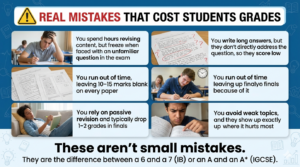
⚠️ Most Students Waste These 4 Weeks, And It Costs Them 1–2 Grades
Every year, we see the same pattern at Young Scholarz.
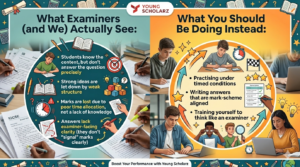
Students work hard in the final month, but in the wrong way. They reread notes, highlight textbooks, and feel productive… yet walk into the exam underprepared for what actually gets them marks.
Result? They drop 1–2 grade boundaries, not because they didn’t study, but because they didn’t prepare strategically.
If you’re in IB (Grade 11/12) or IGCSE, these next 4 weeks are not about doing more. They’re about doing what actually moves your grade.
The Golden Rule: Shift from Learning to Performing
At this stage, content is no longer your biggest problem. Execution is.
Young Scholarz POV:
Top students don’t just revise, they rehearse performance. They make their answers easy to reward.
Week 4: Diagnose Ruthlessly
Your Focus:
- Attempt 2–3 full past papers per subject
- Simulate real exam conditions
- Identify:
- Weak topics
- Question types you avoid
- Time pressure points
The Shift:
Stop guessing what you’re bad at, prove it with data.
Young Scholarz Tip:
Most students overestimate their preparation. Past papers will expose the gap between what you know and what you can execute.
Week 3: Fix Weaknesses with Precision
Your Focus:
- Target only:
- Weak topics
- Repeated question types
- Use:
- Flash summaries
- Active recall
- Blurt + correct method
The Key Difference:
You are no longer “covering the syllabus.”
You are closing scoring gaps.
Young Scholarz Tip:
If a topic won’t realistically come up or carries low weightage, deprioritise it. This is where smart students pull ahead.
Week 2: Master Exam Technique
Your Focus:
- 1 full paper per day (timed)
- Deep review using mark schemes
What to Train:
- Structuring high-scoring answers
- Interpreting command terms accurately
- Writing with clarity and precision
Subject-Specific Focus:
For IB & IGCSE English:
- Clear thesis → focused argument → precise evidence
- Avoid narrative/descriptive drift
For Sciences & Math:
- Method marks = free marks (don’t lose them)
- Show clear working
- Avoid careless errors under time pressure
Young Scholarz Tip:
Students who improve the fastest at this stage are those who learn from their mistakes immediately, not a week later.
Week 1: Refine, Don’t Overload
Your Focus:
- Light revision of high-yield concepts
- Review:
- Mistake journal
- Common traps
- 1 paper per day (max)
What to Avoid:
- Starting new topics
- Studying excessively long hours
Young Scholarz Tip:
Confidence comes from familiarity + control, not last-minute cramming.
High-Impact Strategies That Actually Move Grades:
1. Train Command Terms Like Skills |
2. Make Your Answers “Markable” |
3. Turn Past Papers Into Patterns |
4. Build a Mistake Journal |
Many students lose marks simply by misreading tasks.
|
Examiners don’t hunt for marks.
If your answer is unclear, you lose marks even if your idea is correct. |
Don’t just solve identify:
|
Track:
Review this daily in the last week. |
Final Thoughts: The Last 4 Weeks Decide Your Outcome
At this point, the gap between students is not intelligence or effort.
It’s a strategy. If you’re in IB (Grade 11/12) or IGCSE and want to use these last 4 weeks properly:
- Focus on exam technique
- Practice intentionally
- Learn from mistakes fast
…are the ones who make last-minute jumps in grade boundaries.
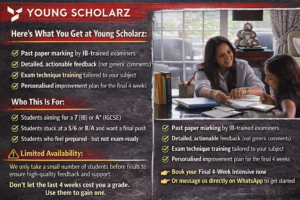
Young Scholarz is here to help
👉 Join Young Scholarz today and start writing like a Band 7 student.