







What Your Teachers Won’t Tell You About IB Exams
If you think you’re losing marks in IB because you “didn’t study enough,” you’re probably solving the wrong problem.
Most IB students put in hours. They highlight notes, reread textbooks, and memorise definitions, yet their scores plateau. What your teachers often don’t explicitly say (or don’t have time to unpack) is this: IB exams don’t reward effort the way you think they reward precision, strategy, and examiner alignment.
Let’s unpack what that really means.
1. The IB isn’t testing knowledge; it’s Testing Interpretation

You can know everything about a topic and still underperform.
In subjects like Language & Literature or History, students assume content is king. It’s not. The IB is marking how you use knowledge, not how much you have. That means:
- Interpreting the question correctly matters more than what you know.
- Staying focused on the task matters more than showcasing everything you’ve studied.
A common issue (we see this constantly at Young Scholarz) is students drifting into what they want to say rather than what the question demands. That’s where marks quietly disappear.
2. “Analysis” Is Not What You Think It Is

Most teachers say “analyse more,” but rarely break down what that looks like under timed pressure.
Students often:
- Identify techniques
- Describe what’s happening
- Explain the obvious effect
And then stop.
But IB examiners are looking for:
- Why was that choice made
- How it shapes meaning in relation to the question
- What deeper idea or implication does it reveal
That jump from description to insight is where top-band answers live.
3. Structure Wins You Marks Before Content Does

This is uncomfortable, but true:
A well-structured, average argument often scores higher than a brilliant but messy one.
IB marking criteria reward:
- Clear line of argument
- Logical paragraph progression
- Consistent focus on the guiding question
If your essay “sounds smart” but lacks direction, examiners can’t reward it fully.
At Young Scholarz, we train students to think of essays like a roadmap:
- Every paragraph has a purpose
- Every point links back to the question
- Nothing is accidental
That’s what creates clarity, and clarity gets marks.
4. Examiners Are Not Reading Deeply; They’re Reading Efficiently

This is something teachers rarely emphasise:
Examiners are scanning for evidence of criteria, not admiring your writing.
They’re asking:
- Is the student answering the question?
- Is there a clear analysis?
- Is the argument sustained?
This means:
- Overly complex sentences can hurt clarity
- Repetition wastes time (and patience)
- Vague ideas don’t get rewarded
Your goal isn’t to impress; it’s to make it easy to award you marks.
5. Your “Comfort Zone” Is Costing You Marks

Students tend to fall back on:
- The same themes
- The same examples
- The same phrasing
It feels safe. But it leads to:
- Repetition
- Shallow analysis
- Predictable arguments
The IB rewards adaptability, your ability to reshape your thinking based on the question. If every essay you write feels similar, that’s a red flag.
6. Timing Isn’t Just About Speed, It’s About Decision-Making

Most advice says, “Practice writing faster.”
That’s incomplete.
High-scoring students aren’t just faster, they’re better at:
- Choosing the right points quickly
- Dropping weak ideas early
- Prioritizing depth over quantity
The real skill is knowing what not to write.
7. Feedback Isn’t Useful Unless You Know How to Use It

You’ve probably seen comments like:
- “Be more analytical”
- “Stay focused on the question”
- “Develop your ideas further”
But unless you’re shown how to fix those, nothing changes.
At Young Scholarz, we’ve seen that improvement happens when feedback becomes:
- Specific
- Actionable
- Repeatable under exam conditions
Otherwise, students keep making the same mistakes just with different content.
8. The Biggest Myth: “If I Understand It, I Can Write It”

Understanding a text or concept ≠ being able to express it under pressure.
IB exams require:
- Structured thinking
- Controlled writing
- Real-time analysis
That’s a skill. And like any skill, it needs targeted practice not just passive revision.
So What Should You Actually Do?

If you want to improve your IB performance, shift your focus:
- From studying more → to studying smarter
- From content-heavy revision → to skill-based practice
- From generic feedback → to targeted improvement
At Young Scholarz, we work with students to break this cycle, turning vague advice into clear systems they can actually use in exams.
Because the truth is:
You’re not losing marks because you don’t know enough.
You’re losing them because you haven’t been shown how to think like the examiner.
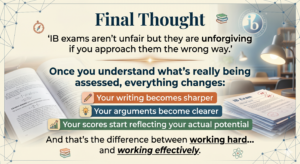
The YS Takeaway
At Young Scholarz, we see this every year: students putting in the hours, yet still dropping marks because they’re preparing the wrong way for what IB exams actually assess.
If you keep relying on passive revision, you’re not just staying where you are; you’re reinforcing the exact habits that cap your scores.
The IB doesn’t reward how much you study. It rewards how precisely you think, structure, and respond under pressure.
The gap between a 5 and a 7 isn’t effort. Its execution.
If that doesn’t change, neither will your results.