








IB vs A-Levels for US Universities: What Actually Matters in Admissions
For families aiming for US universities, the IB vs A-Level debate is often approached the wrong way.
The question is not:
“Which curriculum is harder?”
It is:
“Which curriculum allows a student to build the strongest overall university profile?”
American universities evaluate applicants very differently from systems like the UK or India. Grades matter, but so do:
- Academic rigour
- Intellectual curiosity
- Research and writing ability
- Extracurricular depth
- Leadership and initiative
- Consistency over time
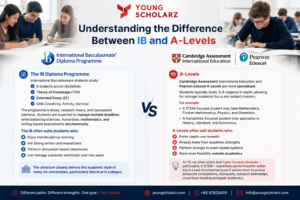
This is why both the IB Diploma Programme and A-Levels can produce exceptionally strong applicants, but in very different ways.
At Young Scholarz, one pattern we repeatedly see is parents choosing a curriculum based on reputation rather than student fit. In reality, the “better” curriculum is usually the one in which the student can sustain excellence while still building a meaningful profile outside academics.
What Do US Universities Actually Prefer?
The truth is: selective US universities respect both curricula. However, they evaluate them differently.
| The IB is often viewed as evidence of: | Meanwhile, strong A-Level applicants are valued for: |
|
|
What matters most is not the label of the curriculum, but how well the student performs within it. A student with:
- Outstanding A-Level grades,
- Research experience,
- Leadership,
- Academic competitions,
- And a clear narrative
can be more competitive than an overwhelmed IB student with average scores and little extracurricular depth. This is something many families underestimate.
The IB Advantage for US Admissions

1. Breadth Aligns Well with American Education
Most US universities do not expect students to specialise immediately.
Even engineering students may continue studying:
- Writing
- Humanities
- Social sciences
The IB naturally prepares students for this broader academic environment.
2. The Extended Essay Builds University-Level Skills
The 4,000-word Extended Essay demonstrates:
- Research capability
- Academic writing
- Citation skills
- Independent thinking
These are highly transferable skills for American higher education.
At YS, we often find that IB students entering US universities adapt more comfortably to freshman writing and seminar-style courses because they have already experienced independent academic inquiry.
3. TOK Encourages Analytical Thinking
Theory of Knowledge pushes students to evaluate:
- Perspectives
- Evidence
- Biases
- Interpretation
This type of analytical thinking is heavily valued in US classrooms.
Where A-Levels Can Be Stronger

1. Greater Academic Depth
A-Level students often develop an extremely advanced understanding within their chosen fields. For competitive STEM applicants, especially, subjects like Further Mathematics and Physics can create a very strong academic foundation.
2. More Bandwidth for Profile Building
One of the biggest realities of the IB is workload intensity. Strong A-Level students sometimes have more time to:
- Conduct research
- Build passion projects
- Pursue internships
- Compete internationally
- Develop extracurricular leadership
For US admissions, this matters enormously. Top applications are rarely built on academics alone.

So Which Curriculum Should You Choose?
Choose IB If the Student: |
Choose A-Levels If the Student: |
|
|
Final Verdict: IB vs A-Levels for US Universities

There is no universal winner.
The IB often aligns naturally with the interdisciplinary, writing-heavy nature of American higher education.
A-Levels often allow students to achieve exceptional subject depth while building stronger extracurricular portfolios.
The stronger choice depends on:
- The student’s personality
- Learning style
- Academic strengths
- Long-term goals
- Ability to balance academics with profile development
At Young Scholarz, we encourage families to stop asking : “Which curriculum sounds more impressive?”
and instead ask: “Which curriculum allows this student to genuinely thrive?”
Because top US university applications are not built on curriculum labels alone. They are built on clarity, consistency, intellectual engagement, and sustained performance over time.