





IGCSE Unseen Poetry (0475 & 0408): Exam Tips, Mistakes & Strategy
Cambridge IGCSE English Literature (0475) | Cambridge IGCSE World Literature (0408) |
Why Unseen Poetry Feels Difficult (But Isn’t Really “Unseen”)
For many students sitting Cambridge IGCSE English Literature (0475) or Cambridge IGCSE World Literature (0408), unseen poetry feels intimidating at first glance.
The reaction is usually the same:
- “What if I don’t understand the poem?”
- “What if I’ve never seen anything like this?”
- “How do I analyse it in 45 minutes?”
These concerns are normal but they come from a misunderstanding.
Unseen poetry is not a memory test. It is not about how many poems a student has studied.
It is a test of something far simpler (and more learnable):
Can you read carefully, think clearly, and build an argument using evidence from the poem?
Once students understand this, their entire approach changes.
0475 vs 0408: What Parents Need to Know

Many parents are unsure what actually separates these two syllabuses. Here is a simple breakdown.
IGCSE English Literature (0475) |
IGCSE World Literature (0408) |
| Cambridge IGCSE English Literature (0475) focuses on developing strong literary analysis skills in English-language texts.
Students study set texts in prose, drama, and poetry. However, Paper 1 includes unseen poetry, where students must analyse a poem they have never seen before without notes, context, or memorisation. Success depends entirely on:
|
Cambridge IGCSE World Literature (0408) is broader and more global.
Students engage with texts from different cultures and literary traditions. The unseen element is especially important here because students cannot rely on familiarity with context or style. Instead, they must:
|
What Both Have in Common
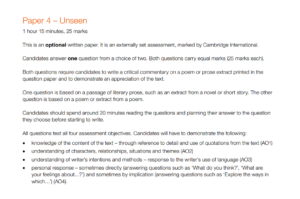
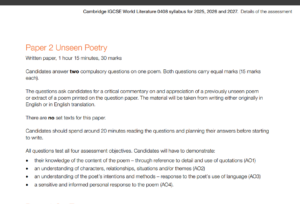
Despite differences, both syllabuses test the same core skills:
- Close reading under pressure
- Language, structure, and form analysis
- Evidence-based interpretation
- Clear written communication
- Ability to explore multiple meanings
Key idea:
Examiners are not asking “Do you know this poem?”
They are asking “Can you think with this poem?”
What Examiners Actually Reward
A common myth is that there is a “hidden meaning” to uncover.
There isn’t.
Examiners reward students who:
- Build a clear, supported interpretation
- Analyse how language and structure create meaning
- Focus on effects on the reader
- Use specific evidence, not general statements
- Show independent thinking, not memorised ideas
- Stay focused and logically structured
Strong answers are not about guessing the “correct meaning.”
They are about arguing convincingly from the text.
Three Mistakes That Lose Marks

1. Jumping to the theme too quickly |
2. Retelling instead of analysing |
3. Fear of ambiguity |
| Students often ask: “What is this poem about?”
This leads to shallow reading. In strong answers, the theme emerges from evidence, not the other way around. |
Paraphrasing the poem is not analysis.
Examiners do not reward “what happens.” Focus areas:
|
Poetry is meant to be open to interpretation.
Students who panic when there is no single answer often lose marks. |
How Young Scholarz Teaches Unseen Poetry

At Young Scholarz, unseen poetry is taught as a thinking process, not a memorisation task.
A typical lesson does not start with techniques.
It starts with observation.
Students first:
- Notice shifts in tone
- Highlight unusual language
- Track emotional movement
- Identify structural patterns
Only after this do they move into analysis.
A key shift in thinking
In class, two students may interpret the same line differently. Instead of deciding who is “right,” students learn to ask:
Which interpretation is better supported by the text?
This is the skill that examiners reward.
The Simple Framework Students Learn
To make exam performance consistent, students use a structured approach:
1. Observe |
2. Infer |
3. Analyse (Build the argument) |
4. Evaluate |
Read closely and notice:
No interpretation yet—just awareness. |
Start forming ideas:
Multiple interpretations are encouraged. |
This is where marks are earned:
|
Offer a clear personal response:
|
What Improvement Actually Looks Like
At the start, students identify basic devices: metaphor, simile, and personification.
Later, they begin noticing:
- Shifts in tone across stanzas
- Structural contrast between opening and ending
- Patterns that build meaning over time
- Subtle ambiguity in word choice
Most importantly, they explain why these choices matter. That is what separates a good answer from a high-scoring one.
Beyond the Exam
Unseen poetry builds more than exam skills. It builds:
- Critical thinking
- Evidence-based reasoning
- Comfort with ambiguity
- Structured communication
These skills carry into IB, A Levels, university, and beyond.
Final Thought

Unseen poetry is not about having seen the poem before. It is about trusting what you can do when you haven’t. Once students stop trying to “guess the meaning” and start learning to build arguments from evidence, everything changes.
Ready to Build Real Confidence in IGCSE Literature?
We work with a small number of students each term to ensure focused, personalised support. If you are exploring preparation for Paper 1 or want clarity on unseen poetry:
Limited spaces each term to maintain individual attention.