







Singapore University Admissions 2026: How Competitive Is It?
Singapore has long been recognised as Asia’s academic powerhouse. In 2026, however, gaining admission to a Singapore university is no longer just about achieving high grades.
The admissions process has become strategic, data-driven, and increasingly holistic. With sustained international demand and carefully controlled intake numbers, universities are redefining what they mean by “merit.” As a result, academic results alone are no longer decisive.
For families in Singapore with children following the IB, IGCSE, or A-level pathways, university applications today are less about being top scorers and more about being academically aligned, intentionally prepared, and intellectually mature.
Below are five key realities every parent should understand about Singapore university admissions in 2026.
1. Singapore Universities Build Selectivity Into Their Admissions

Trends or yearly fluctuations do not drive competition for Singapore universities.
It is built into the system. Universities such as NUS, NTU, SMU, SUTD, and SIT deliberately limit undergraduate intake to preserve:
- Teaching quality
- Graduate employability
- Strong academic engagement
This means that even highly capable students may not receive offers, not because they are weak, but because places are limited by design. In 2026, selectivity is structural. It is not a reflection of student failure.
2. Universities Expect Strong IB, IGCSE and A-level Grades as a Starting Point

Admissions teams expect strong academic performance from applicants based in Singapore. Typical profiles include:
- IB predicted scores in the low-to-mid 40s, with relevant Higher Levels
- Multiple A*s at IGCSE, followed by academically rigorous A-level combinations
- Consistent performance across coursework, internal assessments, and examinations
These results are important, but they are no longer enough on their own. Universities now look closely at academic shape:
- Why were these subjects chosen?
- Do they show progression and depth?
- Is learning driven by curiosity or compliance?
Grades open the door. They no longer guarantee entry.
3. Universities Closely Examine Subject Choices and Academic Alignment

In 2026, Singapore universities assess applications through the lens of the specific degree applied for. A strong overall score may still fall short if subject choices do not clearly support the intended course. For IB students, this often means:
- Higher-level subjects must align with the chosen field
- The Extended Essay should reflect academic direction
- Internal assessments should demonstrate thinking, not just syllabus coverage
Illustrative example:
Two IB students apply for Economics. Both are predicted to score 41 points.
- One student takes HL Economics, HL Mathematics AA, and HL Physics, with an Extended Essay on income inequality.
- The other takes HL Economics but pairs it with unrelated Higher Levels and an EE in a different discipline.
Both students are academically strong. Only one presents a coherent academic narrative. In competitive admissions, alignment matters.
4. Universities Read Personal Statements as Academic Narratives

Universities No Longer Read Personal Statements as Personal Stories. They are evaluated as academic positioning pieces. What weakens an application:
- Generic leadership or volunteering stories
- Broad claims of “passion” without evidence
- Extracurriculars unrelated to the chosen course
A common contrast admissions teams see:
A weaker statement says:
“I have always been passionate about psychology and enjoy helping people. Through leadership roles, I developed communication skills.”
A stronger statement says:
“Studying cognitive bias in IB Psychology led me to question how decision-making changes under pressure. This interest deepened through my Extended Essay on behavioural economics, leading me to examine how psychology informs public policy. The difference is not enthusiasm. It is intellectual specificity.
5. Interviews and Assessments Test How Students Think, Not How Well They Rehearse

For selective programmes, interviews and written assessments often determine outcomes. Universities assess:
- Clarity of thought under pressure
- Ability to reason and adapt
- Ethical and analytical judgement
Students who rely on memorised answers often struggle. Those who can think aloud, respond thoughtfully, and defend ideas logically tend to perform far more strongly. In 2026, admissions teams are selecting students for intellectual readiness, not polish.
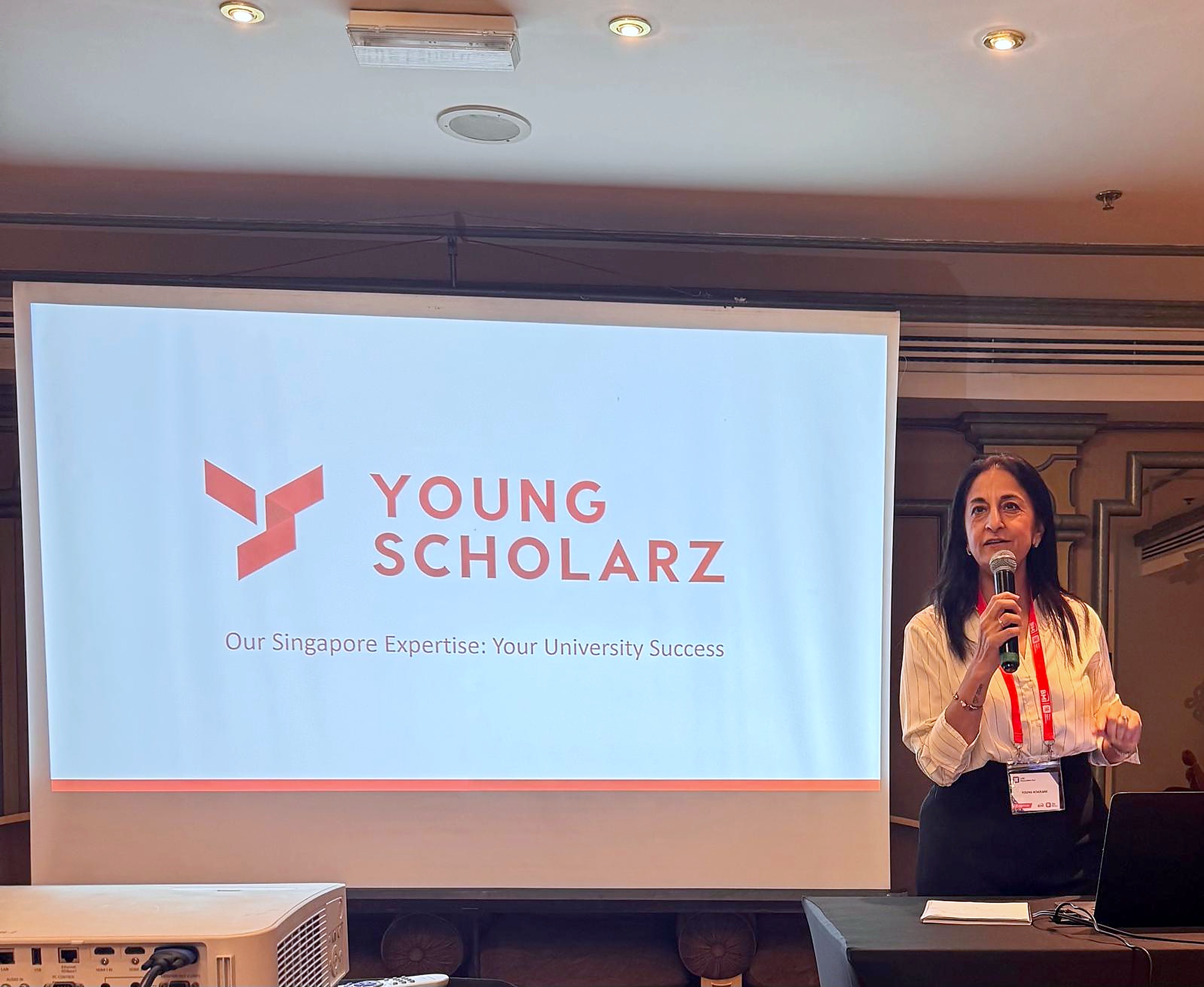
A Young Scholarz Perspective: What Actually Makes the Difference

At Young Scholarz, we work closely with IB, IGCSE and A-level students in Singapore who are academically capable—but often unsure how to translate that ability into a strong university application. What we see consistently is this:
Successful applicants are not doing more. They are doing the right things, early, and with clarity. Strong applications are built over time through:
- Thoughtful subject choices
- Academic depth beyond the syllabus
- Strong writing and critical thinking
- Clear alignment between learning and future direction
In a system as competitive as Singapore’s, intentional preparation matters far more than last-minute excellence. For university applications in 2026 and beyond, the focus is not perfection; instead, it is coherence, confidence, and academic direction.