









Why IB Subjects Like ESS, Film & Sports Science Pull Grades Down
“I took ESS to boost my overall score.”
“Film will balance out my HLs.”
“Sports Science should be manageable.”
If that sounds familiar, you’re not alone.
But here’s the uncomfortable reality: for many IB students, these so-called “easy” subjects don’t boost grades; they quietly pull them down. And the reason isn’t ability. It’s a misunderstanding.
The Myth of the “Easy 7”

Subjects like Environmental Systems & Societies (ESS), Film, and Sports, Exercise & Health Science often feel easier at the start. The content seems intuitive. The concepts feel familiar. There’s less intimidation compared to subjects like Physics or HL Math.
But here’s the catch: Accessibility creates complacency, and complacency costs marks.
Examiner insight: IB examiners consistently report that students underperform in these subjects not because of weak knowledge, but because answers lack depth, precision, and evaluation.
These subjects are designed to assess:
- Interpretation
- Application
- Evaluation not just knowledge
Students who assume they can “figure it out later” often realise too late usually during mocks or final exams that they were never actually exam-ready.
YS Tip: Start treating “easy” subjects like scoring subjects from day one. The earlier you align with mark schemes, the faster your answers improve.
Students Misjudge What IB Examiners Actually Reward

In more structured subjects, expectations are clearer. But in ESS, Film, and Sports Science, success depends on how you think and write not just what you know. In IB mark schemes, top-band responses consistently:
- Directly address command terms like “evaluate” and “to what extent”
- Present balanced arguments
- Justify points with relevant examples or case studies
Yet many students:
- Describe instead of analyse
- State opinions without justification
- Ignore the command term entirely
So even when answers feel “complete,” they often sit in the 4–5 range instead of 6–7.
YS Tip: Before writing, pause and ask: What exactly is this question asking me to do? That one habit can instantly move your answer up a band.
Overconfidence Reduces Practice (and Practice Drives Grades)

Because these subjects feel manageable, they’re often deprioritised especially during busy IB periods. Students:
- Focus heavily on HL subjects
- Skip timed practice
- Avoid past papers until just before exams
But here’s the reality: These subjects are writing-heavy and skill-based meaning performance improves only through consistent, exam-style practice. A common pattern we see:
- Strong understanding of content
- Weak exam performance due to lack of structure and timing
YS Tip: If you’re not writing at least one timed answer a week for these subjects, you’re not preparing you’re just revising passively.
Internal Assessments Quietly Cap Your Grade

In subjects like ESS and Sports Science, Internal Assessments (IAs) carry significant weight and often determine final grade boundaries. Yet students frequently:
- Rush topic selection
- Misinterpret criteria
- Focus on presentation over analysis
Examiner insight: Many IAs plateau in the mid-bands because they lack clear evaluation and critical thinking two key criteria for top marks.
The result? A mid-level IA that caps your overall grade, even if your exam improves later.
YS Tip: Treat your IA like it’s worth 50% of your grade (even if it’s not). That mindset shift immediately raises the quality of your work.
Vague Answers = Average Marks
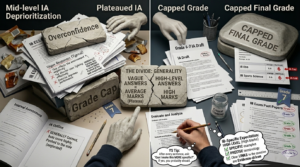
One of the most common reasons students lose marks is generality. Typical responses include:
- “This affects the environment negatively”
- “The director uses lighting effectively”
- “Exercise improves performance”
These aren’t wrong but they’re too broad to score highly. IB-specific expectation: High-level answers must include specific examples, precise terminology, and clear links to the question. Top responses are:
- Specific
- Precise
- Evidence-driven
YS Tip: After every sentence, ask: Can I make this more specific? If yes, you probably should.
Structure Is the Hidden Differentiator

A major gap between mid- and top-band answers is structure. Examiners aren’t just rewarding ideas they’re rewarding how clearly and logically those ideas are developed. Stronger responses:
- Stay tightly focused on the question
- Build a clear line of argument
- Use logical progression between points
- End with a supported judgment
Weaker responses:
- Drift off-topic
- Repeat ideas
- List points without developing them
YS Tip: Think of every answer as an argument, not just a paragraph. If your point isn’t building towards something, it’s not adding value.
The Parent Perspective: What Often Gets Missed

From the outside, these subjects can seem:
- Less stressful
- More engaging
- Easier to manage
But this often creates a false sense of security. Students appear confident. They understand the content. They’re not visibly struggling. And yet, results can drop unexpectedly. Why? Because these subjects demand:
- Early development of analytical skills
- Independent thinking
- Strong writing discipline
Without these, students can seem “on track” right up until mock exams or final results reveal a gap. This is where the real risk lies:
- Grades plateauing at 4s and 5s
- Predicted grades falling short
- University options are becoming limited
So What Should Students Do Differently?

Shift your mindset: These subjects are not “easy.” They are quietly competitive.
They reward:
- Precision over length
- Analysis over knowledge
- Structure over effort
Once you understand this, they can become high-scoring opportunities—not hidden liabilities.
Final Thought
The biggest mistake students make isn’t choosing these subjects. It’s assuming they don’t require a strategy. Treat them casually, and they will cost you marks.
Approach them deliberately, and they can become your strongest scoring subjects.
Don’t Wait Until It’s Too Late
Most students don’t realise where they’re losing marks until mocks or, worse, final exams. By then, it’s harder to fix:
- Weak structure
- Misused command terms
- Underperforming IAs
We’ll show you exactly where you’re losing marks in just one session.
Limited slots each week. As exams get closer, they fill fast.
👉 Book your free session today for personalised feedback, no pressure, just clarity.